Just like inversion, the Conflict Resolution Diagram is a method used to solve problems. However, the Conflict Resolution Diagram is a bit different, as it was made to solve conflicts between two groups, not every problem the business faces. This diagram is meant to not only make it easier to solve arguments within your company, but also in your personal life. This makes the Conflict Resolution Diagram a bit more unique than the other problem solving techniques/diagrams I have discussed so far.
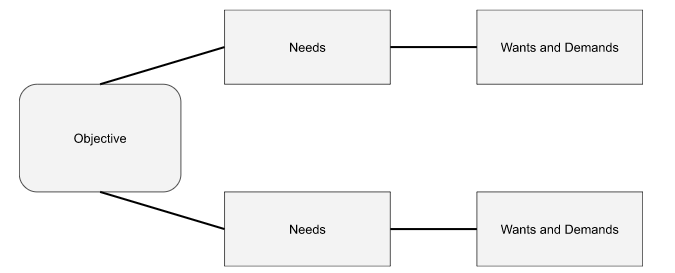
The Conflict Resolution Diagram has three sections to it. The first section is what each side wants. Essentially, what does each party demand? The second section states what each side needs, and the positives of doing what each side wants. The final section wants the shared goal of both sides. What does each side want to come out of everything they do that is the same as the other side?
When you fill out this diagram, you want to fill it out from right to left
This will allow you to find out about a common goal between the two parties. Then, you can figure out a solution that causes the end objective to be reached, which ends in everyone being happy.
Overall, the Conflict Resolution Diagram is an amazing method that can be used in order to resolve a conflict between two opposing sides. I thank you for reading yet another one of my blogs. I humbly request that you read one of my other blogs!
Inversion, just like many of the other topics I have written about, is also a method of problem solving in a business. Inversion is used in order to help you look at a problem from a different point of view. This can allow you to form a better solution.
How inversion works is that you need to find out the worst case scenario for your problem. You need to figure out what solution to your problem will do the absolute worst for you and your company. Once you figure that out, try to deduce what makes that terrible solution such a terrible solution in the first place. Find out about the factors that make the solution horrible. Now that you know what factors lead to a horrible solution, you can work backwards and make a marvelous solution by using the opposite of those bad factors. I will also give you a model to help you understand inversion even more.
To conclude, inversion is a way for people to find out what can make a solution bad, and then use that knowledge to figure out the factors that make a solution good. I thank you for reading, and I hope you check out my other blogs!
Today, I am going to be reviewing another problem solving method known as issue trees. Issue trees help in separating a significant problem into smaller, easier to solve pieces. This can assist you in solving your main problem by solving the smaller problems that are all a part of the original one. There are also two different types of issue trees. So, here is how the issue trees work, and the different versions of them!
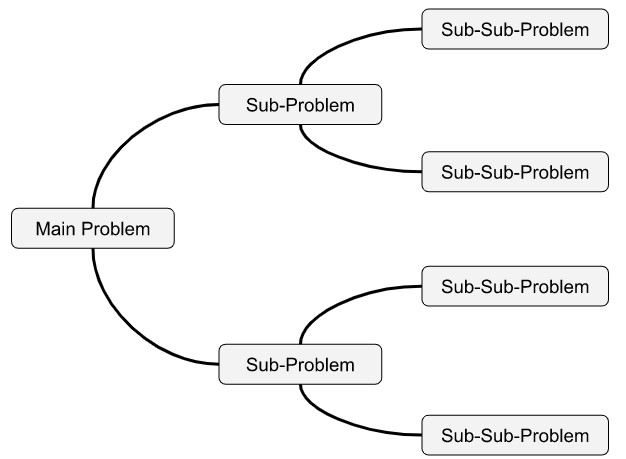
In order to make an issue tree, the first set of actions you need to take is to put the main problem statement in some sort of box on a piece of paper or online drawing. Then, draw lines from this box to the right. Connected to these lines should be multiple boxes filled with sub-problems for the initial problem. After you do this, keep on repeating the second step. Once you find more sub-problems, find sub-problems for those sub-problems! If you continuously do this, you can reach a point where your problem is divided into a few easy problems that you can solve in a blink. Here is a visual to help understand issue trees even more.
Now, while this method is straight forward, there are still some tips to make your life easier when using issue trees! For example, using the 80/20 rule can aid you in saving time finding solutions. The 80/20 rule states that you only have to focus on and solve the most important sub-problems from your issue tree. Eyeing in on a few important issues can have the exact same result as solving every single problem. This can help you save countless hours, especially if you are solving a difficult and long problem.
Another trick is MECE, which stands for mutually exclusive, and collectively exhaustive. The collectively exhaustive means that there are no gaps of information. There is nothing missing, and all of the information is accessible. Mutually exclusive means that everything is covered once and once only. Pieces of information should not be repeated in the issue tree. If you make an issue tree that does not follow either or both of these concepts, then even if you follow the 80/20 rule, your actions will end in failure.
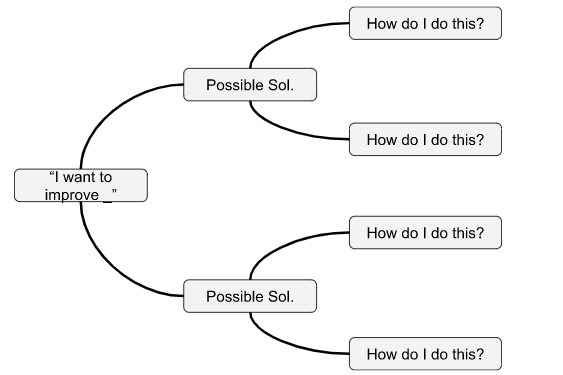
In the very beginning of this post, I said that there are two types of issue trees, and this is when I will cover them. The first type is the problem issue tree, which is the one in the image above. You find sub-problems for your main problem, and continue doing this until you find root problems. This is also known as the why issue tree, because asking why questions is how you find sub-issues. The other version of issue trees are solution issue trees. Solution issue trees are when you ask how questions in order to find a solution to your problem. Here is an example of a solution tree.
In this solution tree, you would start off by putting down what you want to improve in the box to the left. After you complete this, put down a few possible solutions for your problem. Then, you will put down solutions that tell you HOW you would do the possible solutions you just listed. You can repeat this until you find the exact right solution for your problem.
So, now you know everything about Issue Trees and how you can make them. However, before you leave, I want you to take a quick look at an example I made up in order for you to better understand this topic.
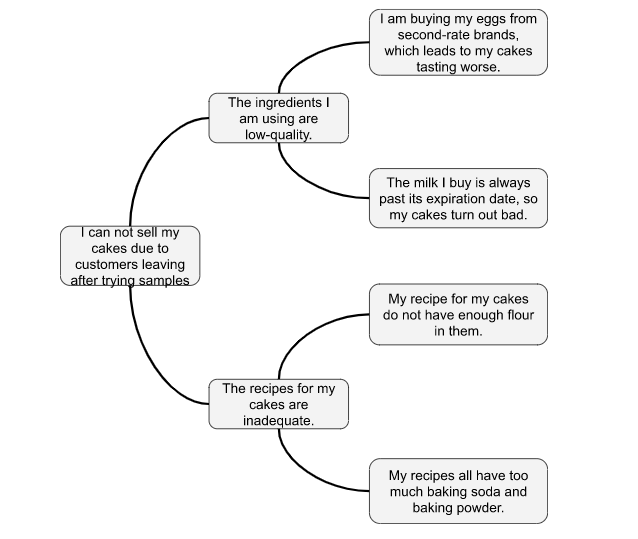
In the example above, let’s assume that I run a bakery. I feel ecstatic about creating a bakery, however in the first few months, while I get a surprising amount of customers, most of them leave after trying my samples. So, I create a problem issue tree, and try to figure out what solutions I can get. In this issue tree, I start off by putting my problem statement, which is that I can not sell my cakes due to customers leaving after trying my cakes. Then, I put down some sub-problems. These consist of me possibly using low-quality ingredients and also using inadequate recipes.
Now that I have my main problem and sub-problems, I can start digging deeper and get to the bottom of why my customers leave after taking samples. For sub-problem 1, I put down that I might be buying eggs from a company that is second-class. This could lead to my products tasting terrible, as I am using nasty eggs in my cakes. Another possible problem could be that I am accidentally using expired milk, and it is pretty obvious that using expired milk would make my cakes taste awful. For sub-problem 2, I put down that my recipes could have too little flour. In baking, using too much or too little of a certain ingredient can ruin the final result. This means that using too much flour will lead to my cakes being dreadful. This concept also applies to my second sub-sub-problem, in which I put down that I may have used too much baking soda and baking powder.
Something to note is that this is definitely not a perfect issue tree. There are definitely better examples out in the endless depths known as the internet. However, I still hope that this specific example at least allowed you to understand issue trees even more than you did before.
In the end, I taught you all about issue trees. I explained the different types of issue trees, gave you diagrams for each type, and even gave you an example. I hope that I was able to teach you at least a tiny bit about issue trees, and I hope that one day, issue trees will allow you to find a solution to a problem you face. Anyways, please check out any of my other blogs about other problem solving methods. I thank you and pray that you have a wonderful day!
Last time, we talked about the fishbone diagram, a model that can be used to solve any problem, especially ones relating to business. Today, I want to inform you about the productive thinking model. The productive thinking model is just like the fishbone diagram in that they were both made in order to help you solve problems. This model has six different steps to it. The first three are just asking questions in order to better recognize the problem you are facing and the possible and favorable outcomes of solving that problem. So, let us go over all of the six steps.
The first step states that you must familiarize yourself with the problem. This means that you need to ask yourself what the problem is, what general information you know about the problem, and etc. Overall, you just want to understand what problem you are facing and what/who is involved with the problem.
The second step tells you to try and figure out what solution will create a favorable outcome for you and your company. You can achieve this by pondering about what the solution should achieve, what it should not achieve, and what limitations you have to a solution(i.e, you might have limited materials or funding for a solution).
The third step states that you have to ask yourself questions that will lead to the preferable solution when answered. These questions are to be made by you, but starting off questions with the words “why” and “how” can help you formulate questions.
The fourth step is essentially making you solve the questions that you constructed in the previous step. You should have many different answers and ideas for each question. Do not worry if an idea seems inadequate. It is still an idea that could possibly be a better solution, even if it does not look like it at first.
The fifth step is just reducing all the answers from step four down to whichever is the best. Once you finish this, start brainstorming on how you are going to implement those solutions.
The final step instructs you to plan and start carrying out the solution(s) that you formed. Make sure that you know what materials and people are required. Once you finally have a plan and have your resources, you can get to assembling your solutions.
Overall, using this thinking process will be essential in your road to becoming a successful entrepreneur. This model will definitely get you out of most sticky situations. In the meantime, enjoy other blogs I have posted, such as my Fishbone Diagram Blog. Please read any other posts I have put up!
Algorithms and data structures are significant parts of our everyday life. From baking a birthday cake to the food you order, algorithms and data structures are used all the time. But what exactly are they?
An algorithm is a set of rules or steps leading to a preferred output. An example of this is setting up a birthday party. When planning a birthday party, there are multiple steps in order to lead to a favorable party where the majority leave happy. First, you would have to choose a good day for the party, where all the participants are available. Then, you would find a location, like a house or a party-specific venue. Next, you could choose what food to bring, the theme, etc. Essentially, in an algorithm, you would keep following a set of finite steps, which could be premade or made by you, in order to reach an ultimate goal.
Since we have learned exactly what an algorithm is, an example of one, and some of the rules that they have to follow, let us learn about a few different types of algorithms. The different algorithms that I have listed are just different ways and approaches to solving a problem. These would be:
Brute Force Algorithm: This is an algorithm where the first solution found is the solution used.
Backtracking Algorithms: In this algorithm, a solution keeps on getting built based on the mistakes of previous solutions, until an ultimate solution is found.
Sorting Algorithms: Sorting algorithms are algorithms where data is sorted in a decreasing or increasing order.
Greedy Algorithms: Greedy algorithms are algorithms where the solution is found step by step. This algorithm is very preferred, as it usually leads to a very preferable solution.
Randomized Algorithms: In this algorithm, the creator uses a random number generator to try and find different solutions, and then uses whichever solution they find best.
Now that we know about algorithms, what are data structures? To put it simply, data structures are a way for people, usually programmers, to store, organize, retrieve, and process data. An example of this would be a food order. When you request food at a shop, the items in your order, their prices, and more have to be remembered in order to satisfy your order. But with most shops having a lot of orders, it is impossible for humans to remember all that data. That is when data structures come in. The employees of the restaurant use the stored and organized data from the computer to make sure the order is right, and the right amount is paid.
Well, we have learned about what data structures are. But we still do not know about the different types of data structures. So let me list a few of them for you!
Stacks: Stacks are an ordered collection of items where everything done in the data structure happens at the end.
Queue: A queue is a data structure where the first element added is taken out and the newest element is in the back, essentially like a line at an amusement park, but for data instead of people.
Tree: A tree is where there are multiple nodes with one single root node. It is a nonlinear data structure.
Hopefully, after reading this article, you have a basic understanding of algorithms and data structures, and how they are important in everyone’s lives!
Problems are the core of a business. The problem a company attempts to solve and the reason for why they want to solve it is the main selling point for any product or service a business provides to a customer. Problems within the process of creating and selling the product/service can also lead to the demise of a company. Finding a solution to these problems is not as simple as it could seem. You might find that you spend countless hours trying to solve one of the many problems that your company faces. While I do not have a secret formula to solve every problem you may face in your business, I do have some techniques I can share with you in order to make your life easier. Today specifically, I am going to teach you about the FishboneDiagram.
The Fishbone Diagram, also known as the Ishikawa Diagram, is a model created by a Japanese professor known as Kaoru Ishikawa in order to help everyone solve problems in their business. Here is an example of the diagram:
In this diagram, you would start off by creating a box and putting whatever problem you are trying to solve in the box.In the example, the problem is that the company is creating bad burgers, so “Bad Burgers” is put inside the box.
Next, you draw a line to the left of the box that describes the main problem. On this line, you will create different branches representing the different elements that are causing the problem to happen. So, in the example above, there are different branches that have categories like the materials(ingredients) of the burgers, which could cause the burgers to be terrible.
Lastly, make separate branches on the branches that describe the sub-problems. On these branches, write down the root of the sub-problem described on the bigger branch. In the sample above, we see that one of the branches has “environment” written on it. Then, in the tiny branches next to it, the weather that causes the burgers to go bad is written down. These are all the steps to creating a fishbone diagram.
Now that you are done with the diagram, you can go backwards, and start solving the root problems. Once you fix all of the root problems, the sub-category problems will automatically be solved, which also solves the main problem. Creating this diagram can let you find out about and then solve all of the root problems.
The fishbone diagram is just one of the many ways that people can solve problems for their company. There are still many different diagrams and methods that can also be used that I plan to share in the future.
First Principles are just another way for entrepreneurs to solve problems. First principles make it so that you can find out the fundamental principles of your problem. How it works is that you first find out what the roots of your problem are. These are what are essentially making you have that problem. Once you find these roots, you should build a solution by solving the root problems you found. However, how do you find out about what your problems’ root causes are?
One method that you can use to find your first principles are the Socratic questions. These are questions that will help you by making you think harder. These questions consist of:
Clarifying concepts: Make sure you know everything about what is going on. “What does this mean?”
Probing assumptions: Think about what could happen if you changed something. “If I did _, then what would happen as a result?”
Probing Reasoning/Evidence: Figure out what reasoning and evidence will support you. “Why is this happening?”
Perspectives: Think about different ways that you could solve the problem. “What if I did _ instead?”
Consequences: Figure out what would happen depending on what action you take. “What would be the consequences if I did _?”
Questions the earliest question: Reflect on the question you asked at the beginning. “Why did I ask this question in the first place?”
Another technique you can use in order to find out about the basic principles of your problem is to use the five whys. The five whys are questions that you create for yourself that start with “Why”. Repeatedly asking these questions can eventually lead to you finding the roots of your problem.
In the example, the parts of a molecule are broken down to the very root and smallest parts.
Overall, first principles are just one of the many ways that entrepreneurs like you use in order to solve problems. I thank you for reading, and I hope you check out some of my other posts!